 English
 русский
 Français
 中文简体
中文简体 Português
 Español
 italiano
 عربى
عربى فارسی
فارسی

The direct answer: a wafer-type Check Valve wins on installation space — it is typically 5 to 10 times shorter in face-to-face length than a swing-type Check Valve of the same nominal bore. On pressure drop, the result depends on flow conditions: a swing-type Check Valve produces lower pressure drop at full, steady flow due to its fully open disc, while a wafer-type (dual-plate) Check Valve introduces slightly higher resistance but responds far faster to flow reversal, making it better for pump protection in dynamic systems.
Understanding the Two Designs
A swing-type Check Valve uses a disc hinged at the top of the valve body on a pivot pin. When forward flow pushes the disc fully open, it swings back against a stop, leaving the full bore largely unobstructed. When flow stops or reverses, gravity and backpressure swing the disc back to the closed seat. This design has been used for over a century in water mains, sewage systems, and general industrial pipelines.
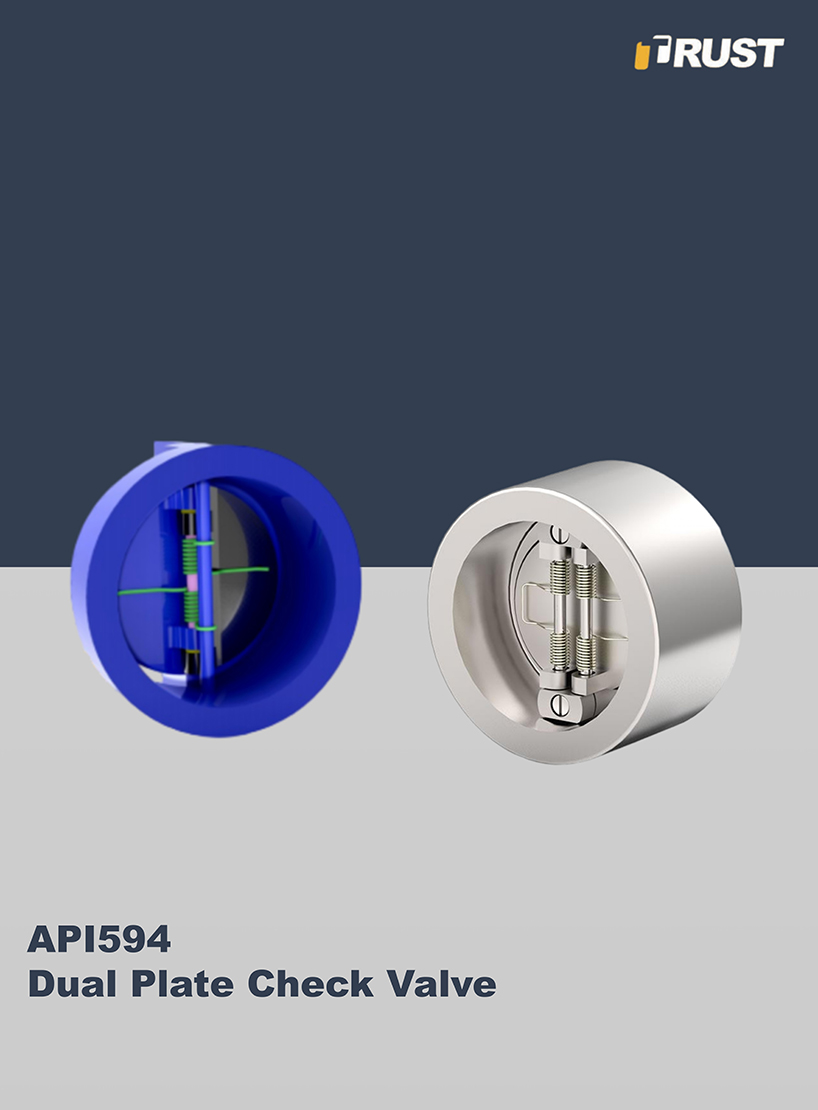
A wafer-type Check Valve (commonly a dual-plate or double-disc design) is sandwiched between two pipeline flanges without its own flanged ends. It contains two spring-loaded semicircular plates hinged on a central shaft. The spring ensures rapid closure the moment forward velocity drops — well before full flow reversal occurs. Its slim profile makes it the default choice wherever piping space is at a premium.
Installation Space: A Clear Advantage for the Wafer Check Valve
Face-to-face dimension is the most immediate practical difference between these two Check Valve types. A swing-type Check Valve needs enough internal body length to allow the disc to swing fully open without touching the upstream pipe bore — this requires a body length that scales with pipe diameter.
For reference, a DN200 (8") swing-type Check Valve to ASME B16.10 has a face-to-face length of approximately 457 mm (18"). An equivalent DN200 wafer-type Check Valve is typically only 46–55 mm (1.8"–2.2") long — roughly one-tenth the length. This difference becomes even more critical in large-diameter pipework.
| Nominal Size | Swing Check Valve Face-to-Face (mm) | Wafer Check Valve Face-to-Face (mm) | Space Saving |
|---|---|---|---|
| DN50 (2") | 178 | 22–28 | ~85% |
| DN100 (4") | 305 | 33–38 | ~88% |
| DN200 (8") | 457 | 46–55 | ~90% |
| DN400 (16") | 762 | 70–85 | ~90% |
Beyond face-to-face length, a swing-type Check Valve also requires additional clearance above the valve body for disc swing travel — this overhead space must be kept free in any installation, a constraint that can be difficult to meet in congested pump rooms or multi-level platforms. The wafer-type Check Valve has no such requirement.
Weight is another installation factor. A DN300 (12") carbon steel swing-type Check Valve at Class 150 typically weighs around 68–80 kg, whereas an equivalent wafer-type Check Valve weighs only 12–18 kg. This significantly reduces pipe support requirements and structural load in elevated piping systems.
Pressure Drop: Where Each Design Performs
Pressure drop through a Check Valve is expressed using the flow coefficient Cv (or Kv in metric) or the resistance coefficient K. A lower K value means less pressure drop at equivalent flow velocity.
Swing-Type Check Valve Pressure Drop
When fully open, the disc of a swing-type Check Valve lies nearly parallel to the flow path, creating minimal obstruction. At high, steady flow velocities (typically above 3–4 m/s for water), the K value for a swing-type Check Valve is in the range of K = 0.6 to 2.5 depending on size and design — relatively low for a non-return device.
However, the swing-type Check Valve has a critical weakness: it requires a minimum flow velocity to hold the disc fully open. If flow velocity drops below this threshold (often around 1.5–2.5 m/s), the disc begins to flutter — oscillating between partially open and partially closed. This causes accelerated wear on the hinge pin and seat, noise, and in severe cases, disc fracture. In systems with variable or low-flow conditions, this is a significant operational risk.
Wafer-Type Check Valve Pressure Drop
A wafer-type (dual-plate) Check Valve always has a central shaft and two half-disc plates in the flow path, even when fully open. This introduces a higher inherent resistance than a fully open swing disc. Typical K values for dual-plate wafer Check Valves range from K = 0.9 to 3.0 — slightly higher than a swing-type at equivalent conditions.
In practice, for a DN150 (6") wafer Check Valve at a flow velocity of 3 m/s in a water system, the pressure drop is typically 0.10–0.18 bar — acceptable in most pump systems where available head far exceeds this value. The trade-off is that spring-assisted closure eliminates disc flutter entirely, making the wafer-type far more reliable across a wide flow range.
Closure Speed and Water Hammer Risk
Closure speed is directly linked to water hammer — the pressure surge generated when a Check Valve slams shut against a reversing flow column. This is one of the most consequential differences between the two types.
A swing-type Check Valve relies solely on gravity and backpressure to close. In large-diameter systems, the disc can take 0.5 to several seconds to close fully after forward flow stops — by which time significant reverse velocity has already developed. The resulting slam can generate pressure spikes of 5–10 times the normal operating pressure in severe cases, risking pipe joint failure and valve body damage.
A wafer-type Check Valve with spring assist closes in less than 0.1 seconds in most cases — fast enough to shut before measurable reverse flow develops. This makes it the standard choice for pump discharge lines, where power failure causes an instantaneous stop in forward flow. The spring force is calibrated to ensure the disc closes against near-zero differential pressure, essentially eliminating the slam condition.
Installation Orientation and Mounting Constraints
Orientation flexibility differs significantly between the two Check Valve types:
- Swing-type Check Valve: Must be installed with the hinge pin horizontal. It can be used in horizontal pipelines or in vertical pipelines with upward flow only. Vertical downward flow installation is not possible, as gravity will hold the disc closed regardless of flow. The hinge axis orientation must be verified during installation.
- Wafer-type Check Valve: Spring-assisted plates allow installation in horizontal, vertical upward, and vertical downward flow orientations — though the spring rate may need to be specified for vertical downward service. This versatility simplifies procurement and piping design.
- Upstream straight pipe run: A swing-type Check Valve requires a minimum of 5–10 pipe diameters of straight pipe upstream to ensure stable, uniform flow and prevent disc flutter. A wafer-type Check Valve typically requires only 2–3 pipe diameters, again saving space in compact installations.
Comprehensive Comparison Summary
| Attribute | Swing-Type Check Valve | Wafer-Type Check Valve |
|---|---|---|
| Face-to-Face Length | Long (e.g., 457 mm at DN200) | Very short (e.g., 46–55 mm at DN200) |
| Weight (DN200, CS) | ~30–40 kg | ~5–8 kg |
| Pressure Drop (K value) | 0.6–2.5 (lower at full flow) | 0.9–3.0 (slightly higher) |
| Closure Speed | Slow (0.5–several seconds) | Fast (<0.1 seconds) |
| Water Hammer Risk | High in large-diameter systems | Low |
| Disc Flutter Risk | High at low/variable flow | None (spring-assisted) |
| Installation Orientation | Horizontal or vertical upward only | Horizontal, vertical up or down |
| Upstream Straight Run | 5–10 pipe diameters | 2–3 pipe diameters |
| Best Application | Gravity/drainage, large water mains, steady flow | Pump discharge, compact systems, variable flow |
Based on the data above, here is a practical framework for selection:
- Choose a swing-type Check Valve for large-diameter gravity-fed water mains, sewage systems, or any application with stable, high-velocity flow where the disc will remain consistently open and installation space is not constrained.
- Choose a wafer-type Check Valve for pump discharge applications (especially where power failure is a concern), compact piping systems, multi-pump parallel headers, HVAC chilled water circuits, and any system with variable or pulsating flow.
- In offshore platforms or modular process skids where every kilogram and every millimeter matters, the wafer-type Check Valve is almost always the only practical option — regardless of pressure drop considerations.
- If the slightly higher pressure drop of the wafer-type Check Valve is a concern in an energy-critical system, verify the actual head loss at design flow rate using the manufacturer's Cv data — in most cases, the energy cost difference is negligible compared to the reliability and space benefits gained.
Selecting the correct Check Valve type is not merely a space or cost decision — it directly affects system reliability, water hammer risk, and long-term maintenance frequency. Matching the Check Valve design to the actual flow conditions of the application is the most important step any engineer or procurement specialist can take.

 No.100 Xiejin Avenue, Funing County Economic Development Zone, Yancheng City, Jiangsu Province
  +86-515-87398111
  office@trustvalve.com