 English
 русский
 Français
 中文简体
 Português
 Español
 italiano
 عربى
 فارسی


A maintenance planner at a chemical plant recently asked why a four-inch stainless steel gate valve on a dilute acid line started passing after only two seasons. Nothing was wrong with the machining. The valve had been throttled monthly to control flow, the wedge never reached its seat under load, and high-velocity media washed out the seating faces — exactly the service a gate valve was never designed to perform.
The short version is simple. A 304 stainless steel gate valve, chosen for the right medium and used strictly for isolation, will reliably outlast the surrounding piping. Its limitations fall into three practical buckets — temperature, chlorides, and throttling — and each one can be handled at the specification stage instead of in the maintenance bay.
What a 304 Stainless Steel Gate Valve Is, and Why It Works
A gate valve is a linear-motion valve: a wedge-shaped or parallel disc slides down into the flow path to shut off flow and lifts completely out of it for opening. Because the bore is full-sized, pressure loss is negligible and flow disturbance minimal. That is why the gate valve remains the default for isolation duty — full flow when open, bubble-tight shutoff when closed, and nothing in between.
The material defines the valve’s character. Type 304 is the best-known austenitic stainless steel, with roughly 18 percent chromium and 8 percent nickel. Chromium forms the self-healing passive oxide film that blocks corrosion, while nickel stabilizes the austenitic structure for toughness and weldability. Cast valves use grade CF8 per ASTM A351; forged components use F304 per ASTM A182. Ratings and dimensions follow ASME B16.34, and API 603 covers flanged stainless bolted bonnet designs.
Compared with carbon steel, a 304 valve costs more and returns dramatically longer service wherever moisture, condensation, or mild acidity is present. Compared with 316L or duplex grades, it costs less and still covers the majority of routine industrial fluids. The economical choice is rarely the cheapest body material; it is the one that isolates the line for two decades without a gland leak.
Know the Three Limits Before You Choose 304
A well-specified 304 gate valve is forgotten once installed. A poorly specified one fails within months, usually in one of three avoidable ways.
- Temperature ceiling. ASME B16.34 ratings limit 304 to about 800°F (427°C). Above that, mechanical strength drops and the alloy begins to sensitize, forming chromium carbides at grain boundaries and losing corrosion resistance. Plan on 400°C or less for continuous service and verify the rating at the actual maximum temperature.
- Chloride stress-corrosion cracking. Above roughly 60°C, with tensile stress and oxygen present, chlorides can crack 304 within months. Warm seawater, brine, and several process streams qualify. If chlorides appear at temperature, step up to 316L at minimum, or duplex in aggressive conditions.
- No throttling. A partially open gate leaves the wedge and seats exposed to high-velocity flow. Erosion undercuts the seating surfaces, vibration loosens the packing, and leakage follows. If the line needs regulation, install a globe or control valve and keep the gate closed or fully open.
304 keeps its toughness down to cryogenic temperatures, which is why stainless gate valves also appear in cold services where carbon steel turns brittle. Low temperature alone is never a reason to avoid 304.
A gate valve that leaks in service was almost always selected wrong, not machined wrong. The material grade, the pressure class, or the opening sequence failed before the seats ever did.
Field observation from industrial maintenance reviews
Cast Body or Forged Body: How the Valve Is Made Matters
Once the grade is fixed, the manufacturing route decides the real differences between two nominally identical valves. For 304, the question is cast versus forged.
Cast CF8 bodies are the workhorse of the stainless steel gate valve family. Casting produces large, complex bodies at moderate cost, which is why nearly every gate valve above four inches is cast. The stainless steel valve series at Trust Valve covers flanged, bolted-bonnet designs from class 150 to class 600, with trim matched to the medium.
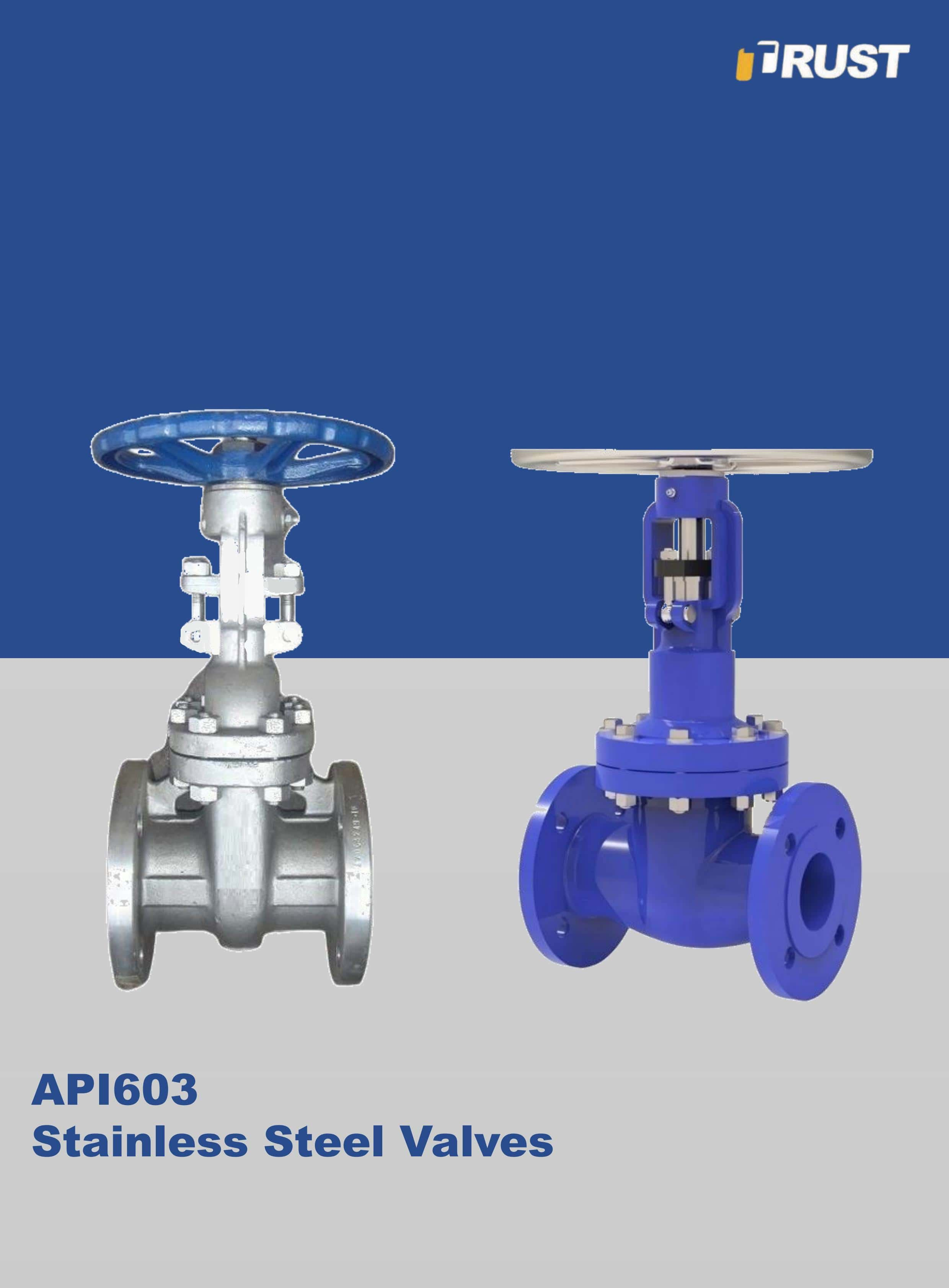 Corrosion-Resistant Stainless Steel Valve SeriesExplore the full austenitic stainless steel valve range for chemical, offshore, and cryogenic services, including gate, globe, and check types across classes 150-2500.View Product →
Forged F304 bodies appear when diameters shrink and pressure ratings climb. Forging closes internal porosity and aligns the grain with the stress path, producing a denser component for compact, high-pressure systems. The forged steel valve range applies that route to gate, globe, and check valves.
 Compact Forged Steel Gate, Globe, and Check ValvesFor high-pressure compact systems, this forged steel line reduces space by 30% and handles corrosive and cryogenic media with fire-safe certification.View Product →
At class 900 and above, the bolted bonnet gives way to a pressure-seal bonnet, where internal pressure presses the cover against the gasket. The higher the class, the stricter the control required over heat treatment and machining, because test pressures grow with the rating. The pressure-seal valve line exists for exactly those duties.
 Pressure Seal Valves for Extreme High-Temperature and PressureDesigned for HTHP duties up to class 4500, these pressure-activated bonnet valves minimize leak paths and suit supercritical steam and hydrocracking.View Product →
A Specification Checklist That Prevents Costly Mistakes
These seven questions, answered in order, turn a vague request into a precise specification.
- Medium. What fluid, at what concentration and pH? Chloride content is the first screening criterion.
- Temperature. Continuous maximum and minimum, plus thermal cycling. This fixes the class and confirms or rules out 304.
- Pressure class. Match the flange rating to the design pressure at design temperature, per ASME B16.5.
- End connections. Flanged for maintenance access, threaded or socket-weld for compact high-pressure lines, butt-weld for permanent joints.
- Stem arrangement. A rising stem reads position at a glance; a non-rising stem suits tight spaces and buried service.
- Trim specification. Confirm seating material and hardness. Hard-faced seats survive steam and dirty fluids far longer than plain 304-to-304 contact.
- Documentation. Material certificates, PMI results, and hydrostatic records should be agreed before the order.
The table compares the four body materials that cover most gate valve specifications in process plants.
| Material | Standard designation | Class range | Max continuous temperature | Relative cost | Best-suited duties |
|---|---|---|---|---|---|
| Cast 304 | ASTM A351 CF8 | 150–600 | 427°C | 1.8× | Water, steam, dilute acids, clean process fluids |
| Forged 304 | ASTM A182 F304 | 800–2500 | 427°C | 2.2× | Compact high-pressure systems |
| Cast 316L | ASTM A351 CF3M | 150–600 | 454°C | 2.6× | Chloride-bearing media, marine exposure |
| Carbon steel | ASTM A216 WCB | 150–2500 | 425°C | 1.0× | Dry hydrocarbons, utility steam; needs coating in wet service |
Note that the material limit is not the valve rating. ASME B16.34 derates allowable pressure as temperature rises, so always check the rating at operating temperature rather than at room temperature.
Where 304 Stainless Steel Gate Valves Earn Their Keep
A plant floor has a short memory for a valve that never leaks. A 304 gate valve earns that reputation wherever carbon steel would rust, contaminate, or seize.
- Chemical and petrochemical processing. Dilute acids, organic solvents, process water, and steam tracing lines where corrosion or product purity rules out carbon steel.
- Oil and gas facilities. Produced water, water injection, and completion fluids, where oxygen and CO2 corrosion are more aggressive than pressure.
- Power generation. Condensate, cooling water, and demineralized water lines, where rust anywhere in the station damages boilers and turbines downstream.
- Food, beverage, and pharmaceutical. The clean surface and easy sanitizing of 304 make it the default for hygienic lines that need full-bore flow.
For a deeper view of how specification changes across process environments, see the chemical and petrochemical industry overview and the oil and gas industry overview.
What You Are Really Paying For, and Where Cheap Quotes Fail
The price of a 304 stainless steel gate valve has four components: the metal, the quality of the casting or forging, machining precision, and the certification trail. When a quote looks suspiciously low, it is usually the last two that were quietly removed.
- Material certification. An EN 10204 3.1 certificate confirms the composition and mechanical properties of the specific heat. Without it, there is no verifiable proof that the casting is 304.
- Heat treatment and PMI. Solution annealing restores corrosion resistance after casting and welding; positive material identification verifies the installed alloy. Both are sometimes skipped to cut cost.
- Seat and disc trimming. Standard 304-to-304 seating suits clean media. Stellite overlay or hardened 316 seating lasts many times longer in steam, dirty water, and abrasive solids.
- Hydrostatic testing. Each valve should ship with shell and seat test records per API 598 or ISO 5208, at the tightness class agreed in the purchase order.
A stainless steel gate valve with no body marking, no test report, and no material certificate is an unverifiable product. In pressure-retaining or safety service, that risk outweighs any discount.
In sour service containing hydrogen sulfide, NACE MR0175 sets hardness and material limits. Ask explicitly whether the casting, weld overlay, and fasteners comply; the word stainless alone is not an answer.
Mark the delivered valve, file its certificate with plant records, and check the body marking against the order. A few minutes now will save hours of tracing after a decade of silent service.
The Bottom Line
The 304 stainless steel gate valve is not an exotic special. It is the correct answer for a large share of industrial isolation duties, and it fails almost always for the same three reasons: excessive temperature, chloride stress-corrosion cracking, or use as a throttling valve. Select the right grade, respect the pressure class, match the trim to the medium, and insist on documentation. The valve will then quietly outlast the plant’s memory of its own construction.



 No.100 Xiejin Avenue, Funing County Economic Development Zone, Yancheng City, Jiangsu Province
 +86-515-87398111
 office@trustvalve.com
