 English
 русский
 Français
 中文简体
 Português
 Español
 italiano
 عربى
 فارسی


Stainless Steel Check Valves
A 3000 psi stainless steel check valve can pass every hydrostatic test in the shop and still fail inside its first year of service, because the pressure figure on the nameplate settles only one of the five questions a specification has to answer.
Picture a chemical injection skid. The line never sees more than 500 psi, yet the 316 stainless check valve marked 3000 psi CWP is chattering within weeks and passing fluid back through the seat before the first maintenance window. Pressure was never the problem. A spring chosen for the wrong cracking pressure, a seat material running thirty degrees past its ceiling, and a valve bolted straight onto the pump flange did the damage.
The conclusion first: four decisions determine whether a stainless check valve survives at 3000 psi. What the figure actually refers to, which grade carries it at operating temperature, which design matches the flow, and how the valve is installed, tested and documented. Everything else is detail.
What 3000 psi Means on a Check Valve Datasheet
On a valve datasheet, 3000 psi is not one specification. It is at least three, each governed by a different document, and buyers who treat them as interchangeable end up comparing quotations that are not comparable.
| Where it appears | Governing reference | What it fixes | What it leaves open |
|---|---|---|---|
| 3000 psi CWP on a forged or bar-stock valve | ASME B16.34 and API 602 practice | The body cold working pressure at 100 F, based on material group and minimum wall thickness | Allowable pressure at operating temperature, plus seat, spring and trim limits |
| 3000 psi working pressure on wellhead equipment | API 6A | The equipment working pressure at its rated temperature | Bore, trim, sealing type and product specification level, which are set separately |
| 3000 psi circuit design pressure | Customer or hydraulic system practice | The maximum the circuit is designed to see | Whether the valve itself carries any margin above that figure |
| Class 1500 flange | ASME B16.34 and B16.5 | A pressure class, not a pressure; the psi value depends on material group and temperature | Nothing, provided you read the pressure-temperature table for the actual grade |
The most common mix-up is between a pressure class and a pressure. ASME B16.34 names classes, not psi values, and the psi value behind a class depends on material group and temperature. A Class 1500 carbon steel body sits near 3700 psi at 100 F. The same class in a lower-strength stainless group, or at 400 F, is rated lower again. A buyer who writes 3000 psi and a supplier who quotes Class 1500 can therefore agree in principle and disagree in practice.
A rating is a pressure at a temperature. Take away the temperature and you are left with a number, not a rating.
The second mix-up is temperature. A cold working pressure rating is exactly what the name says. A valve rated 3000 psi CWP may have an allowable pressure well under half of that at the temperature a blocked-in line reaches in summer with the pump stopped. Ask for the pressure-temperature table for the exact grade, then compare it against the worst credible case rather than the normal operating case.
Which Stainless Grade Carries 3000 psi, and Where It Stops
Stainless steel is a family, not a grade, and the differences matter far more at 3000 psi than at 150 psi. The practical options for pressure-containing bodies are:
- 316 and 316L, in cast CF8M or forged F316 form, the default for check valves in clean and mildly corrosive service. 316L welds more predictably; 316 offers slightly higher strength for the same wall thickness.
- Duplex 2205, with roughly twice the yield strength of 316, so a lighter body reaches the same rating with better resistance to chloride stress corrosion cracking.
- Super duplex 2507, for high-chloride and sour duties where 2205 is marginal.
- 304, a cost option only where chlorides are low and temperatures are moderate.
- 347 and 321, stabilised grades for elevated-temperature lines.
- Alloy 20, 904L and 6Mo, for acids and seawater, where the pressure body is the easy part and the chemistry is the hard part.
Corrosion, not pressure, is what usually ends the life of a stainless check valve. Grade 316 begins to suffer chloride stress corrosion cracking in warm, concentrated chloride service, so a brine or seawater line specified loosely as stainless may need duplex or a 6Mo grade rather than a thicker 316 body. Where the line is sour, NACE MR0175 and ISO 15156 compliance belongs on the purchase order, because it changes hardness limits, certification and sometimes the grade itself.
Wall thickness is the other half of the story. A 3000 psi cold working pressure body is not a thicker version of an 800 psi body; it follows the ASME B16.34 minimum wall chart for its material group, and that difference is what the buyer is paying for. Material certificates to EN 10204 3.1, with heat numbers traceable to the nameplate, remain the only practical way to confirm it at goods-in.
Matching the Check Valve Design to the Line
Design choice decides head loss, closing speed and what happens the instant a pump trips. In stainless service at 3000 psi, five designs cover almost all of the work.
| Design | Sealing element | Response to reverse flow | Head loss | Where it earns its place |
|---|---|---|---|---|
| Swing check | Single disc on a hinge pin | Closes with reversing flow, can slam | Lowest of the common designs at full bore | Clean liquids in horizontal lines with space for pipe runs |
| Dual plate | Two spring-loaded plates | Fast, low-inertia closing | Low, with a compact face-to-face dimension | Tight spaces, vertical lines and retrofit work |
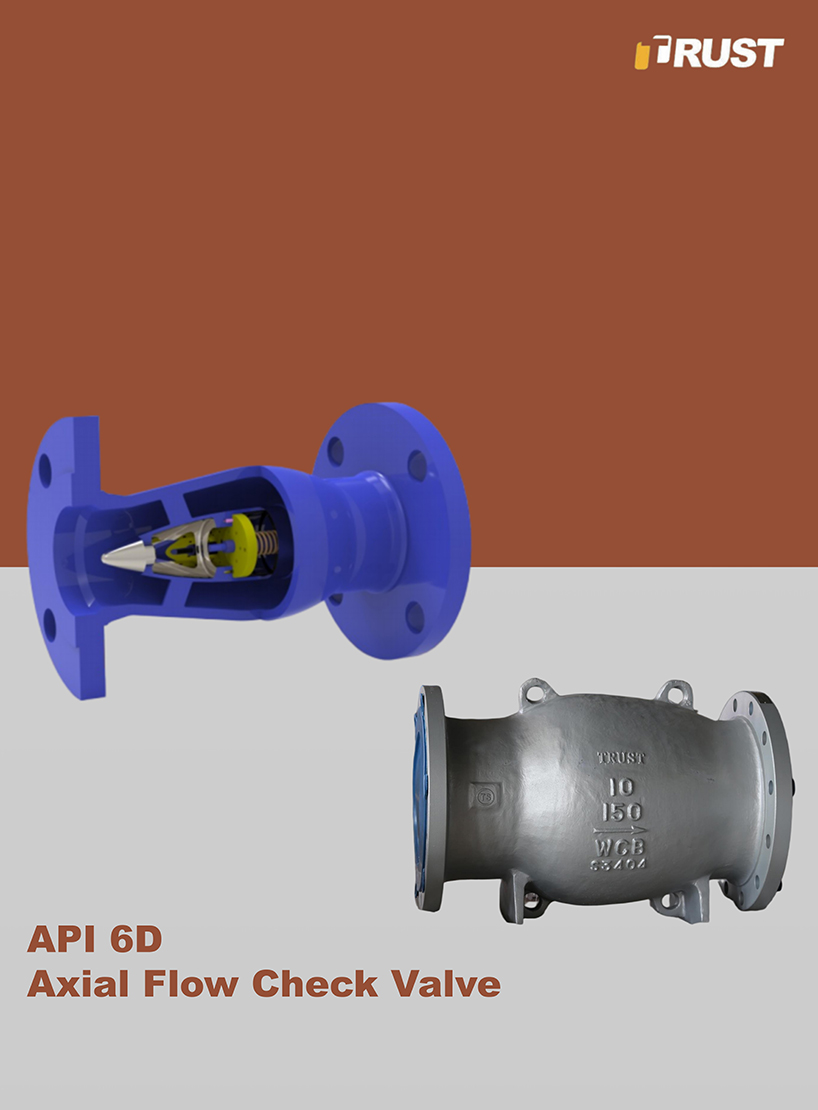
| Axial flow | Spring-loaded disc guided on the axis | Very fast, non-slam | Moderate but stable across the flow range | Pump and compressor discharge, high cycling |
| Piston or lift | Piston inside a guide | Fast, short travel | Higher than swing or dual plate | Small sizes, high pressure, clean fluid |
| Ball check | Ball seated on a machined seat | Simple and comparatively slow | Moderate to high | Slurries, viscous and dirty media |
Swing check valves remain the default for clean liquids in horizontal lines, where full bore and low head loss are worth more than closing speed. The trade-off is slamming: a swing disc travels further than a plate, and on a fast-reversing line that travel becomes a surge event. The geometry behind that behaviour is set out in our guide to swing check valve selection.
Where space is tight, or the line runs vertically, a dual plate design earns its place: two spring-loaded plates, a short face-to-face dimension and a lower cracking pressure than most metal-seated alternatives of the same rating.
Springs, Seats and Trim: What Decides Service Life
The pressure rating gets a valve onto the line. The spring, the seat and the trim decide how long it stays there.
Spring selection sets cracking pressure, and cracking pressure is a system decision rather than a habit. A soft-seated dual plate valve may open on a fraction of a psi, while a metal-seated axial flow unit may need several psi to lift clear of the seat. Choose against the pump curve and the minimum controllable flow, and make sure the spring itself is stainless. A carbon steel spring inside a stainless body is a corrosion site waiting for the first condensate.
Seat material then sets the temperature ceiling. Typical guidance, to be confirmed against the supplier datasheet:
- PTFE and reinforced PTFE, to roughly 400 to 450 F in clean service.
- PEEK, to roughly 600 F, with better extrusion resistance than PTFE.
- FKM, to roughly 400 F, sensitive to some solvents and amines.
- EPDM, to roughly 300 F, strong on water and weak on hydrocarbons.
- Metal-to-metal seats, for the widest temperature range, with API 598 acceptance criteria that permit measurable leakage and must be matched to the specification.
Installation and Procurement Checks That Prevent Rework
Most field failures that do not begin in the body itself trace back to installation and documentation. The installation points worth writing into the method statement are:
- Mount a swing check horizontally with the cover up, or vertically with flow upward. Never install it on vertical downflow.
- Keep five to ten pipe diameters of straight run between a pump discharge flange and the check valve.
- Verify the flow arrow against the isometric, and confirm the disc cannot be held open by weld slag or scale.
- For vertical lines, prefer dual plate or axial flow designs over a swing disc.
- Where reversal is fast or the surge analysis is unfavourable, specify a spring-assisted design and check its closing time against that analysis.
On the procurement side, the checklist is short but rarely complete:
- The pressure-temperature basis, with the grade and the standard named on the datasheet.
- EN 10204 3.1 material certificates, with heat numbers traceable to the nameplate.
- Shell and seat test reports to API 598, with the acceptance criteria agreed in advance.
- The product standard, such as API 594 for dual plate designs or API 6D for pipeline valves.
- NACE MR0175 and ISO 15156 certification when the line is sour.
- Spare plates, springs and gaskets available in the same material as the original trim.
For gathering, compression and pipeline duties, that documentation package carries as much weight as the valve itself, which is why the same discipline applies throughout oil and gas operations where certificates are audited at commissioning.
Where reverse flow can arrive in under a second, a spring-loaded axial flow check valve closes along the axis of the line on a short, light stroke, which is why it is the usual answer to non-slam requirements on pump and compressor discharge.
The specification that works is short and unglamorous. Name the grade and the pressure-temperature basis. Name the design and the spring. Name the seat material with its temperature ceiling. Name the test standard and its acceptance criteria. Name the end connection standard. Name the documentation package. Six lines, and each one removes a failure mode that has nothing to do with pressure.
3000 psi stainless steel check valves are not a difficult purchase. They are an easy purchase to get wrong, because the number that attracts all the attention is the one that decides the least about how long the valve lasts. Pressure ratings win the quotation. Material, spring and seat selection win the service life.


 No.100 Xiejin Avenue, Funing County Economic Development Zone, Yancheng City, Jiangsu Province
 +86-515-87398111
 office@trustvalve.com
