 English
 русский
 Français
 中文简体
 Português
 Español
 italiano
 عربى
 فارسی


A stainless steel flanged gate valve rarely fails because someone machined the wedge badly. It fails because the body grade came off a stock list, the flange facing did not match the mating line, or the trim and packing were left to the supplier's default.
Here is the short version. Match the body grade to the real chloride level and operating temperature, confirm the pressure class against the material's own rating curve rather than the carbon steel one, and put trim, packing and test requirements in writing on the purchase order. Those three decisions explain most of the difference between a valve that lasts fifteen years and one that leaks at its first thermal cycle.
The rest of this article walks through why each decision matters, which standards and tolerances apply, and where the money actually goes when you specify stainless.
Why Flanged, Stainless and Gate — and Where the Combination Stops Working
A gate valve is an isolation device, not a control device. The wedge lifts fully clear of the bore, so at full open the pressure drop is close to that of an equivalent length of pipe, and the design is bidirectional. That is exactly what a header isolation point or a tank outlet needs.
Flanging adds the maintenance argument. A flanged valve can be unbolted, inspected and replaced with hand tools and a torque wrench — no hot work permit, no cutting into a live line. On stainless piping it also protects the fabricator's weld quality: the joint stays where it was made, and the valve remains a replaceable component rather than a permanent one.
The combination does have limits worth stating plainly.
- Throttling. A part-open wedge invites wire drawing, vibration and seat damage. Use a globe valve or a characterized quarter-turn valve instead.
- Frequent cycling. Gate valves are slow and carry more moving parts than a butterfly; high-cycle lines belong to quarter-turn designs.
- Large low-pressure water lines. Above roughly DN 600, the weight, operating torque and cost of a stainless gate valve become hard to justify.
- Solids and slurry. The seat pocket traps particles. Knife-gate or full-port ball valves handle that duty better.
Choosing the Body Grade: CF8, CF8M, CF3M or Duplex
The cast grades are what you see on the nameplate: CF8 for 304, CF8M for 316, CF3M for the low-carbon 316L. The difference that matters in the field is molybdenum — roughly 2 to 3% in CF8M, which is what keeps pitting resistance usable in chlorides. CF8 does not have it.
A practical summary of how the common grades actually compare:
| Body grade | Typical service | Watch-out | Commercial note |
|---|---|---|---|
| CF8 (304) | Demineralized water, dry air, solvents, some food-grade lines | Pitting risk wherever chlorides are present | Lowest cost, widest availability |
| CF8M (316) | Cooling water with mild chlorides, dilute acids, coastal atmosphere | Pitting above roughly 60 °C with high chloride levels | The default for most chemical service |
| CF3M (316L) | Nitric acid, pharmaceutical, welded assemblies | Same corrosion profile as 316, lower carbon | Preferred where sensitization is a concern |
| CD3MN (duplex 2205) | Seawater, brine, produced water, high-chloride streams | Not recommended above roughly 300 °C | About twice the yield strength, longer lead time |
| CF8C (347) | Elevated temperature, intermittent thermal cycling | Limited by packing and gasket, not the casting | Stabilized grade for creep-range duty |
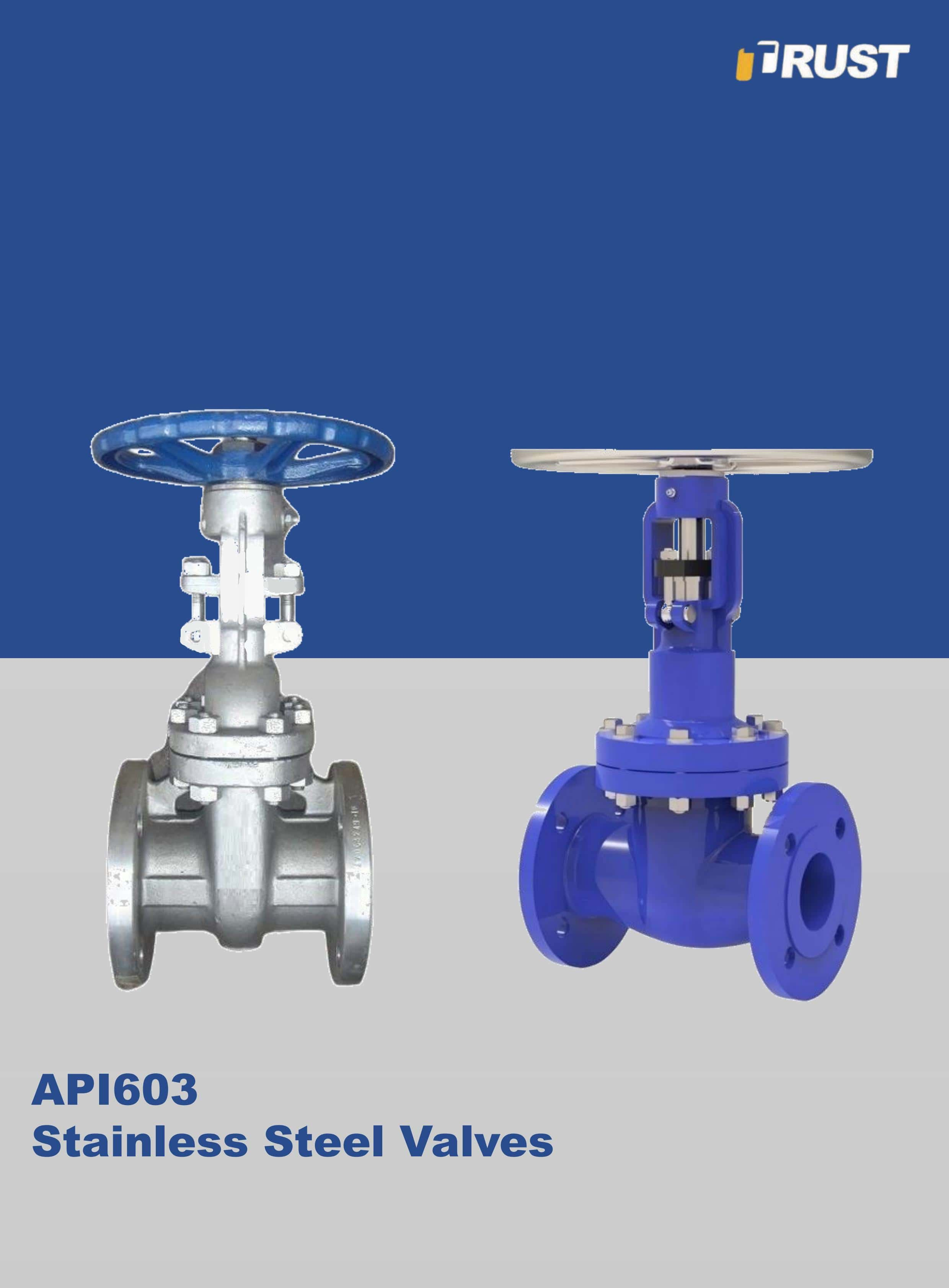 API 603 Stainless Steel Gate, Globe and Check ValvesReview this stainless steel valve range for corrosive chemical and petrochemical service, including gate, globe and check designs in 304, 304L, 316 and 316L grades.View Product →
At NPS 4 and below, many suppliers offer a forged stainless body under API 602 rather than a casting, and the wall thickness and bonnet design differ noticeably. On small-bore, high-pressure lines that is often the better value — but it is a different product, and the data sheet should state which one you are buying.
Flange Details That Cause Most Site Rework
The body grade gets the attention; the flange causes the arguments. Four parameters belong on the data sheet regardless of how simple the line looks.
Flange parameters to confirm before release
- Standard and size. ASME B16.5 covers up to NPS 24. Larger sizes follow B16.47 Series A or Series B, and the two are not interchangeable.
- Facing. Raised face is the default; flat face limits bolt load when mating to cast iron; ring-type joint appears at Class 900 and above.
- Bolt hole orientation. Valves are normally supplied with holes straddling the centerline. If the line was designed to a two-holes-perpendicular convention, say so explicitly.
- Face-to-face dimension. ASME B16.10 fixes it by class and size; a short-pattern body will need a spool piece on site.
Pressure class needs the same care. A Class 300 stainless gate valve is not simply a stronger version of the carbon steel equivalent — the two sit in different material groups in ASME B16.34, so allowable pressure falls away with temperature at different rates. Reading a stainless rating off a carbon steel table is a common and expensive mistake, particularly between 200 °C and 400 °C.
From Class 900 upward, and especially in the larger sizes, stainless gate valves are often built with a pressure-seal bonnet rather than a bolted flanged bonnet. Line pressure acts on a split ring to make the seal, which removes a large part of the bolt and body weight at high ratings.
 Pressure Seal Gate, Globe and Check ValvesFor Class 900 and higher lines, this pressure-seal range covers gate, globe and check valves up to Class 4500, with quick-change trim and sour-service options.View Product →
Mixing flange standards between valve and pipeline is the most common cause of avoidable site delay. A Series B valve will not bolt to a Series A flange, even at the same nominal size and pressure class.
Trim, Packing and Gaskets: The Small Parts That Decide Leakage
Two valves with identical bodies and identical nameplates can behave completely differently because of what sits inside them.
- Trim. 13% Cr for clean water and steam, 316 for dilute chemical service, Stellite-faced for erosive or high-cycle duty. Hardfacing is not automatically better; it changes cost, lead time and thermal behaviour.
- Stem. 17-4PH for high-strength stems, 316 where corrosion governs. Rising stems show position at a glance; non-rising stems save headroom.
- Packing. PTFE at the low end of the temperature range, flexible graphite above roughly 200 °C. If the site runs a fugitive-emission programme, ask for ISO 15848 testing at the class you actually need — a certificate without the class is not evidence.
- Bonnet gasket. Spiral-wound 316 with graphite filler is the usual choice; ring-joint or lens rings appear at high pressure.
Sour service adds another layer. NACE MR0175 / ISO 15156 governs acceptable hardness and grades, and it applies to trim, stems and bolting as well as to the body.
A valve that passes a hydrostatic test in the factory can still fail its first thermal cycle on site. Specify the test that matches the duty, not the test that is easiest to pass.
Where Stainless Earns Its Premium
Stainless bodies are justified when the medium is aggressive enough that carbon steel would need coating, frequent replacement, or both. In chemical and petrochemical plants the familiar cases are dilute acid lines, chloride-bearing cooling water, solvent recovery and tank farm manifolds — the service profile set out in this chemical and petrochemical industry overview.
In oil and gas, stainless gate valves appear more often on produced-water and utility systems than on the main hydrocarbon line, where carbon steel with the right trim remains the norm. Power generation uses stainless for demineralized water and some flue-gas desulphurization areas; mining and metallurgy use it selectively where slurry chemistry defeats lined carbon steel.
If you are replacing an existing carbon steel or lower-grade stainless installation, it is worth reading these stainless steel valve upgrade considerations before the specification is frozen.
What to Verify Before You Approve a Supplier
Once the specification is right, the remaining risk is whether the valve that arrives matches the paper. A short checklist covers most of it.
- Material certificates to EN 10204 3.1, with heat numbers traceable to body, bonnet and trim.
- Pressure test records per API 598, showing actual test pressures and hold times rather than a tick box.
- Fire-safe certification to API 607 or ISO 10497 wherever the line carries hydrocarbons.
- Dimensional verification against ASME B16.10 face-to-face and the declared flange drilling standard.
- A documentation package covering operation and maintenance, packing torque values, spare parts and a named after-sales contact.
A valve ordered only as "316 stainless, flanged, Class 150" will usually arrive with 13% Cr trim, PTFE packing and no third-party test report. If any of those is critical to the duty, it has to be written into the order rather than assumed.
What This Means for Your Next Order
Stainless steel flanged gate valves are a mature product; the engineering is rarely the risk. The risk sits in the gaps between process data sheet, purchase order and packing list. Match the grade to chloride and temperature, check the pressure class against the material's own rating, state the flange facing and drilling, and name the trim, packing and test standard you expect.
Do that, and the valve becomes what it should be: equipment you install once and forget about until the next turnaround.


 No.100 Xiejin Avenue, Funing County Economic Development Zone, Yancheng City, Jiangsu Province
 +86-515-87398111
 office@trustvalve.com
